Your Current Security Stack Doesn't Protect Your AI. Here’s Why That Should Terrify You.
· AI Security, AI, Artificial Intelligence, Cybersecurity, IT Security, AI Firewall, AI Proxy, AI Cyber Attacks, MITRE ATLAS, OWASP, EU AI Act
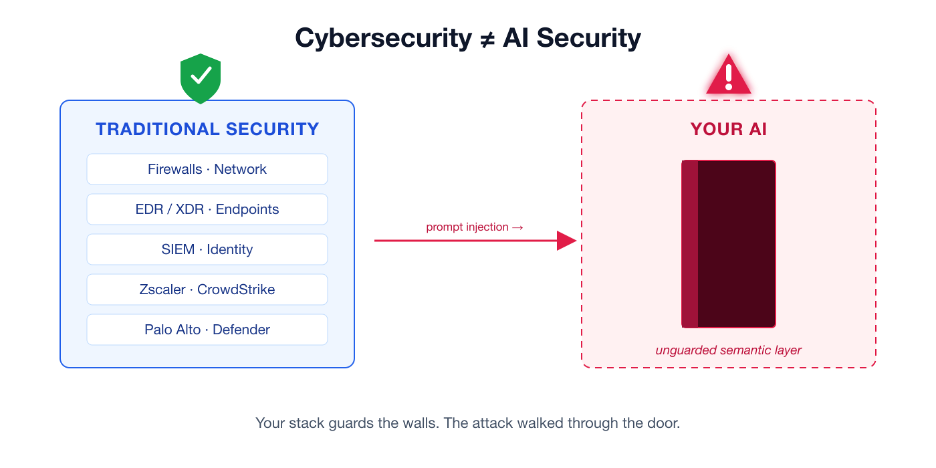
There’s a sentence I hear in nearly every enterprise security conversation right now, and it’s almost always said with total confidence:
“We’re covered. We’ve got CrowdStrike, Defender, Zscaler - the works. Our AI is secure.”
It’s the second most expensive misconception in the market today. See my previous article for the first biggest cybersecurity misconception: “The Shared Responsibility Illusion: Where Cloud Provider AI Protection Ends -and Yours Begins”
Because here’s the uncomfortable truth: your world-class cybersecurity stack was never designed to protect an AI system, and in most cases, it can’t even see the attacks that target one.
This isn’t a knock on those tools. CrowdStrike, Palo Alto, Microsoft Defender, Zscaler, Cisco, your EDR/XDR, your firewalls, your SIEM - they are excellent at what they were built to do. The problem is that “what they were built to do” and “securing an AI” are two different problems that happen to share a budget line.
Let me explain the gap, because once you see it, you can’t unsee it.
The analogy that makes it click
Believing your EDR protects your LLM is like believing your antivirus software protects you against accounting fraud.
Both are real threats. Both can cost you millions. Both belong under the broad umbrella of “risk.” But antivirus scans binaries for malicious signatures and behavior - it has no concept of a fraudulent journal entry, a colluding vendor, or a cooked quarterly close. You wouldn’t fire your auditors and point at your antivirus license. That would be absurd.
Yet that’s structurally the same mistake organizations make when they assume network-and-endpoint security equals AI security.
Different problems require different disciplines. AI security is a different problem.
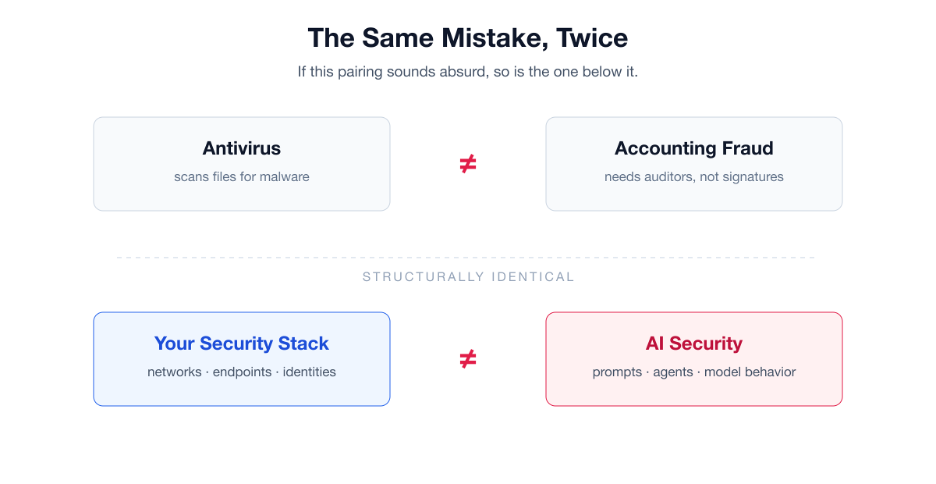
Figure 2: Antivirus is to accounting fraud what your security stack is to AI security - structurally the same mismatch.
What traditional cybersecurity actually protects
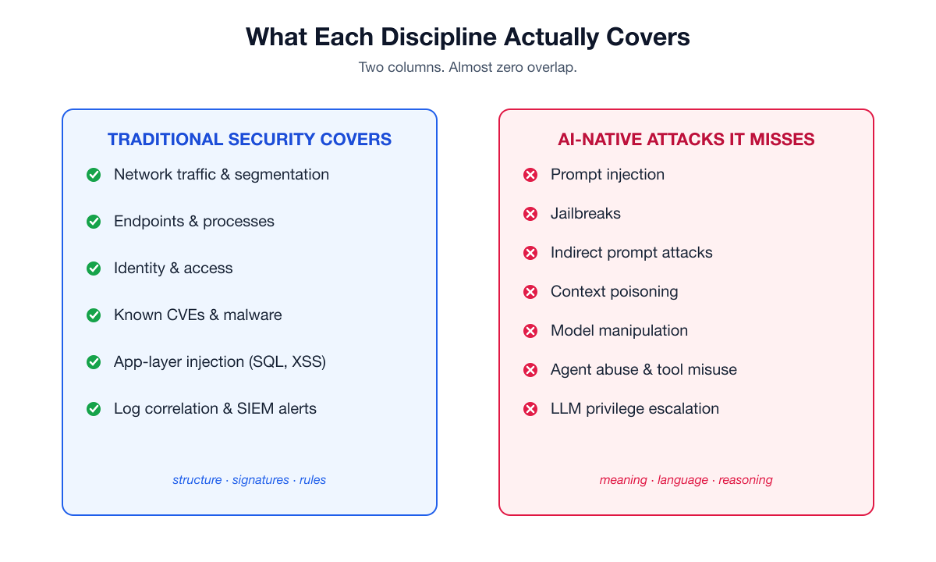
Your existing stack is built around four decades of hard-won assumptions about how systems get attacked. It protects:
Networks - segmentation, traffic inspection, east-west movement
Endpoints - laptops, servers, containers, and the processes running on them
Identities - who is logging in, from where, with what privileges
Applications - known CVEs, injection at the code layer, misconfigurations
These controls share a common worldview: there is trusted code, and there is untrusted input, and the boundary between them is enforceable. A firewall knows a port. An EDR knows a process. A SIEM knows a log pattern. They operate on structure, signatures, and rules.
That worldview breaks the moment you deploy a large language model.
Why AI breaks every assumption
An LLM doesn’t have a clean boundary between “code” and “data.” The instructions and the input are the same thing - natural language. That single property is the root of an entire new attack class your firewall has never heard of.
Here’s what traditional cybersecurity fundamentally does not understand:
Prompt injection. An attacker embeds instructions inside the text your model reads, and the model obeys them. To your SIEM, it’s just… text. A valid HTTPS request with a 200 response.
Jailbreaks. Carefully crafted prompts that dissolve the model’s guardrails and coax it into doing what it was told never to do. No malware. No exploit payload. Just words.
Indirect prompt attacks. The malicious instruction isn’t even typed by a user - it’s hidden in a webpage, a PDF, an email, or a support ticket that your AI agent later reads. The user is innocent. The document is the weapon.
Context poisoning. Corrupting the retrieved knowledge, memory, or RAG pipeline that your model trusts, so it confidently returns attacker-controlled answers.
Model manipulation. Nudging outputs, extracting training data, or reverse-engineering behavior through probing.
Agent abuse. Your AI agent has tools - it can send emails, query databases, hit APIs, execute code. An attacker who controls the agent’s instructions controls those tools.
Tool misuse. Getting the agent to call a legitimate function in an illegitimate way - the “confused deputy” problem, reborn for the AI era.
LLM privilege escalation. Manipulating an agent into acting with permissions or reaching data the user was never authorized to touch.
Read that list again and ask yourself honestly: which of your current tools detects even one of them?
The answer, for almost every organization, is none. Not because the tools are bad - because these attacks don’t look like attacks. They look like normal traffic, normal prompts, normal documents. The malice lives in the meaning of the language, and meaning is exactly what a packet inspector, an endpoint agent, and a log correlator cannot parse.
The invisible gap in your architecture
Picture your security architecture as a series of walls. Perimeter firewall. Network segmentation. Endpoint agents. Identity and access management. Application security.
Now drop an AI agent into the middle of that fortress. It has legitimate credentials. It makes legitimate outbound calls. It reads legitimate documents. Every wall you built waves it through, because from their perspective, nothing is wrong.
The attack surface didn’t disappear. It moved - to a layer none of your existing controls were built to watch: the semantic layer, where instructions and data are indistinguishable and the model’s own reasoning becomes the thing you have to defend.
That’s the gap. And it’s widening every time a team ships a new copilot, connects an agent to a tool, or wires an LLM into a customer-facing workflow.
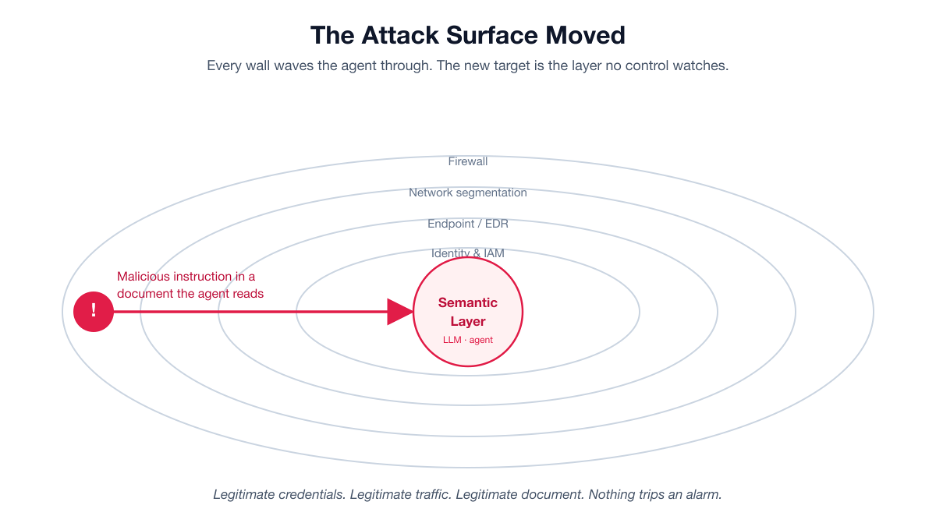
Figure 4: Concentric defensive walls; the attack slips past all of them into the unguarded semantic layer at the core.
What AI security actually requires
If AI security is a different discipline, what does the discipline look like? It’s a new stack, sitting alongside - not replacing - your traditional one:
Input and output guardrails that inspect prompts and responses for injection, jailbreak, and data-exfiltration patterns
Least-privilege agent design - scoped tools, scoped permissions, human-in-the-loop for high-impact actions
Context integrity - trust boundaries and provenance for RAG, memory, and retrieved content
AI-specific red teaming - testing your model the way an attacker would, not the way a pentester tests a web app
Runtime monitoring for AI behavior - detecting anomalous tool calls and reasoning, not just anomalous network flows
An AI asset inventory - you cannot secure the models, agents, and integrations you haven’t even catalogued
Notice that almost none of these map onto a control you already own.
That’s the whole point.
The takeaways
If you remember nothing else, remember these:
Cybersecurity ≠ AI security. They overlap in budget and org chart, not in capability.
Your existing tools are blind to AI-native attacks - prompt injection, jailbreaks, indirect attacks, agent and tool abuse - because those attacks look like normal language and normal traffic.
The attack surface moved to the semantic layer, where “code” and “input” are the same thing and your firewall has no visibility.
AI security is a distinct discipline requiring its own guardrails, red teaming, least-privilege agent design, and runtime monitoring.
Doing nothing is a decision - and right now, it’s the default one most organizations are unknowingly making.
The companies that get breached through their AI in the next few years won’t be the ones without security budgets. They’ll be the ones who assumed the budget they already had covered a problem it was never built to solve.
Antivirus doesn’t stop accounting fraud. And CrowdStrike doesn’t stop a prompt injection.
So here’s my question for you: if an attacker hid a malicious instruction inside a document your AI agent will read tomorrow - which of your current tools would even notice? Drop your answer in the comments. I read every one.
This article was drafted using artificial intelligence tools to assist with content generation, and subsequently reviewed, heavily edited, and fact-checked by a human editor to ensure accuracy, quality, and originality.
If this reframed how you think about AI risk, give it a clap or two so it reaches the security leaders who still think their SIEM has this covered. Follow for more on the collision between AI and security.


 Onnex
Onnex